
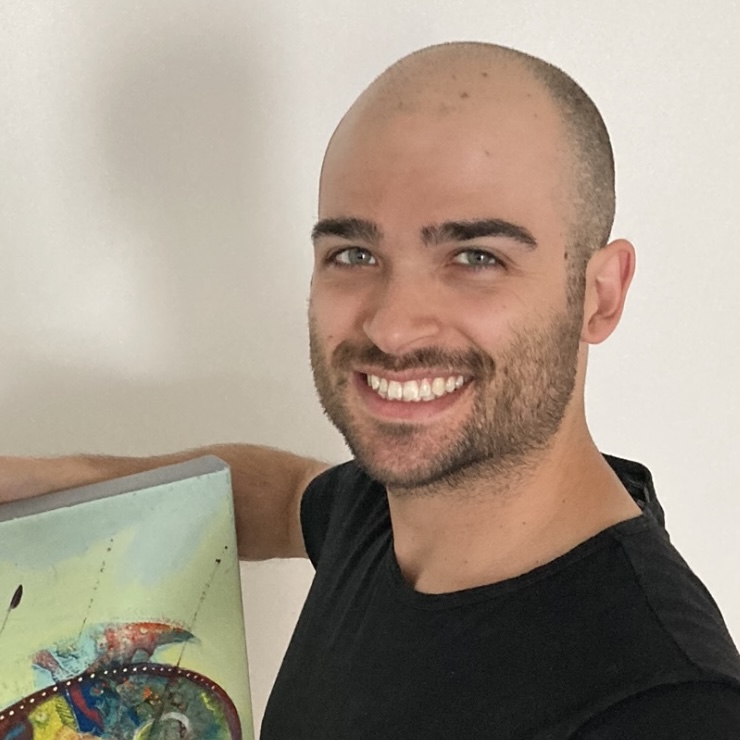
Sam Cowin
Sr Computer Vision and Machine Learning Engineer
How did you first become interested in computer vision?
A little over 10 years ago, I was a research assistant in an undergraduate robotics lab, where I was tasked with teaching a robot to understand external stimuli and respond with appropriate emotions. While the methods were far less advanced than today’s approaches, the experience of instructing a machine to interact with its surroundings was incredibly eye-opening – and it’s something I’ve been drawn back to ever since.
What are you currently working on, and why is it important?
My current work focuses on what happens when the traditional barriers to countering imposters begin to fail, particularly as generative models become more capable. I draw on my background in generative modeling and threat analysis to anticipate likely attack vectors and design countermeasures.
This work matters because there is an ongoing arms race between those creating increasingly convincing fakes and those trying to detect them. Even more concerning, if we can no longer trust the media used to train computer vision systems, then model performance becomes irrelevant.
How could your work change the way people interact with digital media?
As these threats become more common, I hope my work helps people better understand what to look for when interacting digitally, whether with individuals or organizations. Until recently, we’ve operated under a loose assumption that the person on the other end of a call or message is who they claim to be. As that assumption weakens, people will need both tools and guidance to navigate communication channels that are now deeply ingrained in daily life.
How do you stay motivated and creative in your work?
Working on problems with real societal impact while staying at the technical frontier makes motivation come naturally. The team at GetReal is also a huge part of that. On a more personal level, growing up in a family of teachers shaped how I approach creativity. I’ve seen firsthand how the same subject can be explored from many angles, and how authenticity and clarity can turn understanding into insight. I’m reminded of that every day, and I try to carry that mindset into my work.
What do you do outside of research? Any surprising hobbies or passions?
For the last several years, my biggest hobbies have been rock climbing, scuba diving, and traveling, especially for live music. When I am not doing something adventurous or outdoors, I am usually cooking and working on my recipe book.
What’s one piece of advice you’d give to aspiring researchers?
Being able to articulate the implications of your work to different audiences is just as important as the results themselves. If you discover something truly exciting but no one can follow along, it limits the impact – and honestly, it is less fun.